Go3 sends. We listen.
The question lands with the picture.
A mock of the real link Guntars described: a broadcaster pushing its Sport 1 channel to us over SRT, nine megabits a second, picture plus four audio tracks. Built, run and tested end to end on one laptop.
01 / the whole thing, moving
Follow one goal through both sides.
GO3
JOIN IN LIVE
THE
INTERNET
INTERNET
SRT · AES-256
CHANNEL
Sport 1, a mock match
picture + 4 audio tracks
picture + 4 audio tracks
PLAYOUT
in real time,
9 Mbps, never stops
9 Mbps, never stops
CALLER
dials out to us,
encrypted
encrypted
LISTENER
always waiting
on one port
on one port
DECODE
once, then split
into four outputs
into four outputs
PREVIEW
operators watch,
switch language
switch language
RECORD
10 s files,
tonight becomes replay
tonight becomes replay
CROWD
original track,
no commentary
no commentary
COMMENTARY
Lithuanian track,
what was said
what was said
+13.3 dB
“Įvartis! Nordsport…”
BUFF
roar = moment,
words = which team
words = which team
HOLD 3.0 s
JOIN IN LIVE · LIVE
Northport score! Who gets the next goal?
NorthportEastvaleNo more goalsTwo details carry the design. The engine listens to the original sound, where a goal is a crowd, the same in every language. And it holds the question back, because we receive the goal before the viewer sees it.
02 / measured, not claimed
What the test actually recorded.
9.3Mbps, steady, over SRT
Guntars asked for 9
Guntars asked for 9
40.0 smoment detected
the goal is at 40.0 s
the goal is at 40.0 s
+13.3dB of crowd over its
20 second baseline
20 second baseline
2.0 sfor Scribe to read
the commentary
the commentary
3.0 sheld, so the question
lands with the picture
lands with the picture
8 sfeed cut, receiver
recovered on its own
recovered on its own
0false moments before
the goal
the goal
15/15end-to-end checks
passed, 67 s
passed, 67 s
03 / four tracks, one signal
Why we listen to the crowd, not the commentator.
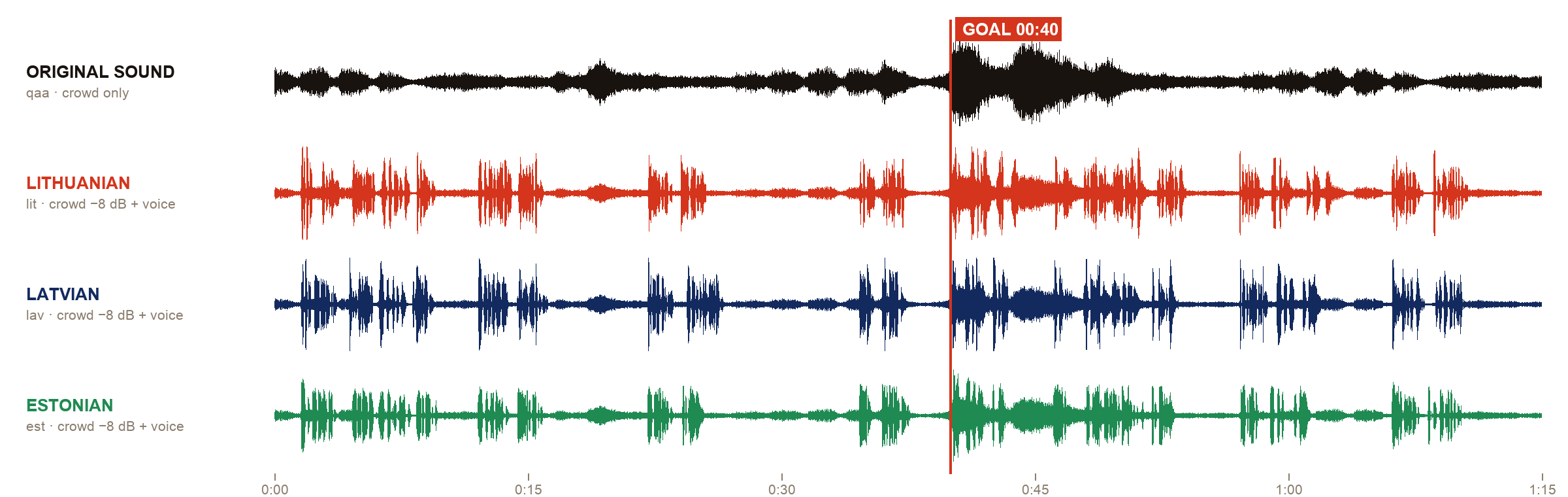
04 / the test signal
75 seconds of a match, on repeat.

05 / mock vs the real feed
What changes when Go3 switches on.
| This mock | Go3, from Guntars' reply | |
|---|---|---|
| WHO CALLS | The mock encoder, as SRT caller | Go3, as SRT caller. Same |
| FROM | 127.0.0.1 | 85.254.183.41, allowlisted on our firewall |
| TO | localhost, UDP 9000 | A public static IP and one UDP port, that we send them |
| SIGNAL | 9 Mbps AVC transport stream | 9 Mbps AVC transport stream. Same |
| AUDIO | Original, Lithuanian, Latvian, Estonian | Original plus EE, LV, LT. Track order to confirm |
| SOURCE | A 75 s file on a loop | Sport 1, 24 hours a day |
| PASSPHRASE | Generated locally, never shown | Generated by us, sent to Guntars separately |
For go-live: an address, a firewall rule and a passphrase. The receiver code does not change.
06 / run it
Two commands.
# start both sides: the receiver listens first, then Go3 calls
./run-demo.sh
# Go3 console:    http://localhost:8100   (has the "cut the feed" button)
# JiL receiver:   http://localhost:8200

# the end-to-end test: real SRT, real audio analysis, 15 checks
node test.mjs

./stop-demo.sh